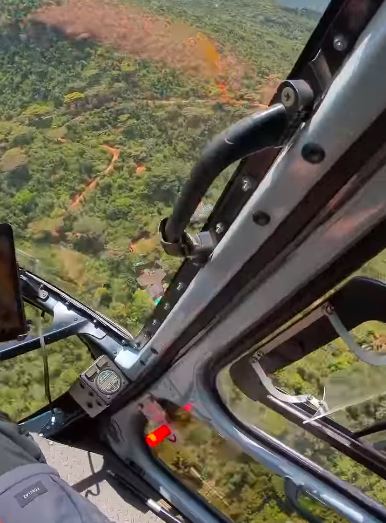
Views by Tropic ir at Mount Kenya National Park in Laikipia County
At first, it seems obvious: if a helicopter has a fuel tank, why not simply fill it before every flight?
The answer is surprisingly simple—fuel is heavy.

Can you spot the helicopter from Tropic Air at Nanyuki Airstrip?
Every litre of aviation fuel adds weight to the helicopter. While more fuel increases the distance a helicopter can fly, it also reduces how much weight the aircraft can safely carry in passengers, cargo, medical equipment, or rescue gear. This balance between fuel and payload is one of the most important calculations pilots make before every takeoff.
Every Helicopter Has a Maximum Takeoff Weight
A helicopter is designed with a Maximum Takeoff Weight (MTOW). This is the heaviest the aircraft is allowed to be for a safe takeoff.
That total weight includes:
- The helicopter itself
- The pilot and crew
- Passengers
- Luggage or cargo
- Fuel
If the total exceeds the approved limit, the helicopter's performance is affected. It may require a longer takeoff, climb more slowly, consume more fuel, or, in extreme cases, be unable to take off safely.
Why More Fuel Isn't Always Better
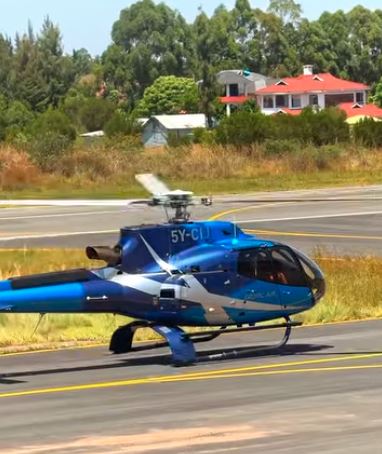
A Blue Helicopter by Tropic Air at Nanyuki Airstrip
Imagine a helicopter that can safely weigh 3,000 kg at takeoff.
- Helicopter: 2,000 kg
- Pilot: 80 kg
- Four passengers: 320 kg
- Equipment: 100 kg
This leaves 500 kg available for fuel.
If the operator decides to completely fill the tanks with 700 kg of fuel instead, the helicopter becomes too heavy. The pilot must either:
- Remove passengers,
- Carry less cargo, or
- Reduce the amount of fuel.
This is why many helicopters leave the ground with only the fuel required for the mission, plus legally required safety reserves.
Helicopter Fuel Capacity Varies by Model
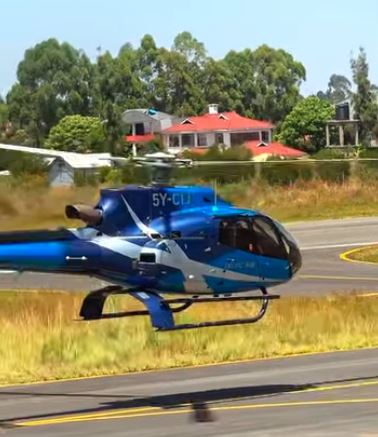
A helicopter landing at Nanyuki Airstip by Tropic Air
There isn't one standard helicopter fuel tank size.
Smaller helicopters may carry only enough fuel for a few hours of flying, while larger offshore, military, or VIP helicopters can carry much larger quantities or use auxiliary fuel tanks to extend their range.
The exact capacity depends on:
- Aircraft model
- Mission type
- Passenger load
- Distance to destination
- Availability of refuelling points
Fuel Planning Is a Safety Calculation
Pilots don't simply estimate how much fuel they need.
Before every flight, they calculate:
- Flight distance
- Expected flight time
- Weather conditions
- Wind speed and direction
- Passenger and cargo weight
- Fuel consumption rate
- Mandatory reserve fuel
This ensures there is enough fuel to complete the journey safely while keeping the helicopter within its certified operating limits.
Why Tourist and Charter Helicopters Often Don't Fill Their Tanks
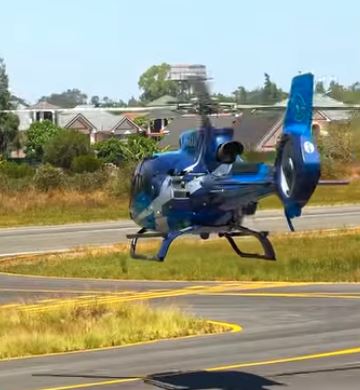
a blue air bird landing a Nanyuki airstrip
Many sightseeing, charter, medical evacuation, and construction helicopters operate relatively short flights.
Instead of carrying unnecessary extra fuel, operators often:
- Refuel more frequently,
- Carry additional passengers or equipment,
- Improve aircraft performance,
- Reduce operating costs.
This allows the helicopter to use its available weight more efficiently.
Frequently Asked Questions
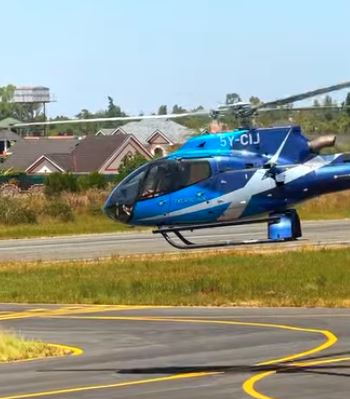
A 5Y -CIJ helicopter landing at Nanyuki airstrip by Tropic Air
How many fuel tanks does a helicopter have?
Most helicopters have one or more integrated fuel tanks, depending on the aircraft's design and mission requirements.
Do helicopters use petrol or diesel?
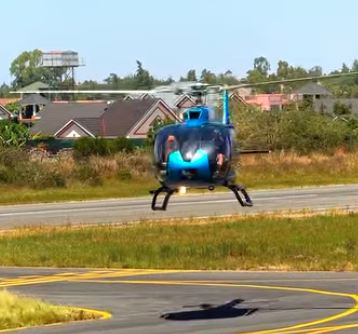
A helicopter landing at Nanyuki airstrip by Tropic air
Most modern helicopters use Jet A or Jet A-1 aviation turbine fuel, which is kerosene-based. Some smaller piston-engine helicopters use aviation gasoline (Avgas).
How long can a helicopter fly on one tank?
Flight time depends on the helicopter model, payload, weather, and fuel capacity. Many civil helicopters can remain airborne for around 2 to 4 hours before refuelling.
Why is helicopter fuel expensive?
Jet fuel must meet strict aviation safety standards, and operators also factor in storage, transport, quality control, and airport refuelling infrastructure.