Understanding the KRA Current Retail Selling Price (CRSP) Schedule
The Current Retail Selling Price (CRSP) is one of the most important documents used by the Kenya Revenue Authority (KRA) when calculating import duty for used motor vehicles. Rather than relying solely on the price you paid in Japan or another exporting country, KRA maintains a comprehensive database containing thousands of vehicle models and their official retail values.
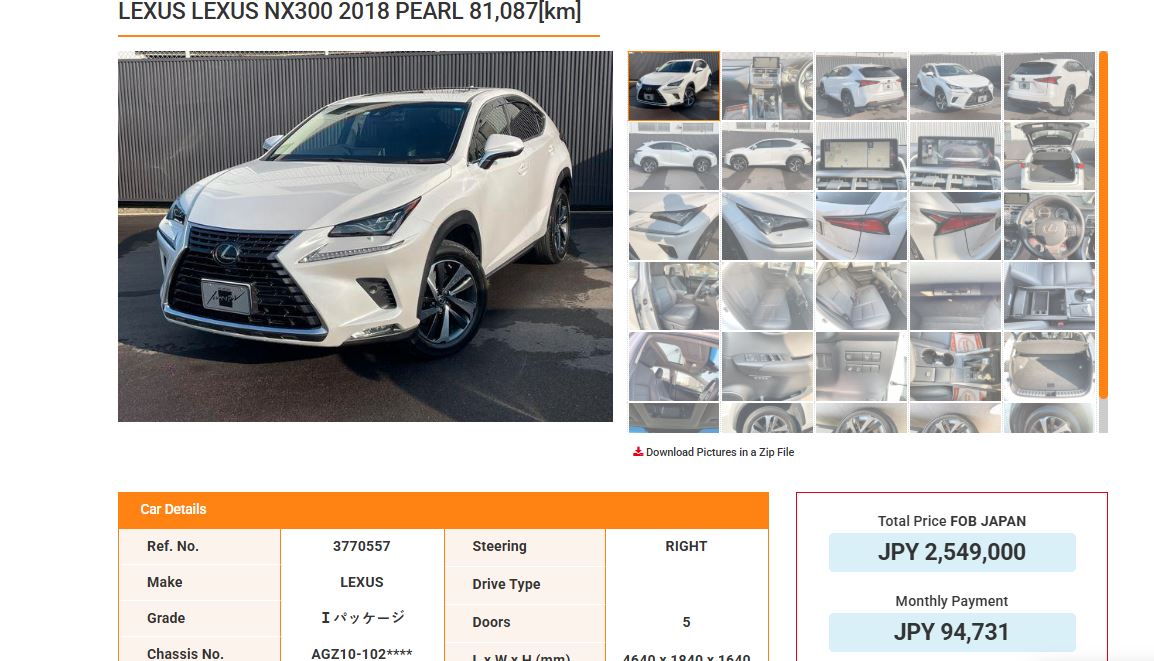
FOB is not what KRA uses to assess taxes on imported used vehicles. For many imported used vehicles, KRA bases valuation on the CRSP (Current Retail Selling Price) schedule and applies depreciation according to its valuation rules, rather than simply accepting the purchase invoice. That approach helps reduce undervaluation through artificially low invoices.
Each vehicle entry includes key specifications such as the make, model, engine capacity (cc), body type, gross vehicle weight (GVW), seating capacity, fuel type, and the corresponding CRSP value in Kenyan shillings. This standardized approach ensures that similar vehicles are assessed consistently for customs purposes.
We Don't Sell. We Solution.
Turning complex vehicle sourcing into confident buying decisions.
Calculate Total Landing Cost Now>
What Information Does the CRSP Schedule Contain?
Every row in the CRSP schedule represents a specific vehicle variant. The database typically includes:
| Field | Description |
| Make | Vehicle manufacturer, e.g. Toyota, Lexus, Mazda, Isuzu, Nissan |
| Model | Exact model or trim level such as Land Cruiser 250 VX, Yaris Cross, Wish, or Voxy |
| Engine Capacity | Engine size measured in cubic centimetres (cc) |
| Body Type | Vehicle category such as SUV, Sedan, Wagon, Pickup or Van |
| Gross Vehicle Weight (GVW) | Maximum permissible vehicle weight |
| Seating Capacity | Number of passenger seats |
| Fuel Type | Petrol, Diesel or Hybrid |
| CRSP (KES) | KRA's reference retail selling price used for customs valuation |
When they Stop, We Start.
At Monolith Africa, we don't sell vehicles—we solution every step of the journey. From vehicle sourcing and auction verification to foreign exchange, shipping, financing, customs, and delivery, we help you understand the entire supply chain so you can buy with confidence.
Estimate the Total Cost of Importing Your Car
Importing a vehicle into Kenya can save money and give you access to a wider range of models, but many buyers underestimate the total cost. The price you see in Japan is only one part of the journey. Once shipping, insurance, customs taxes, and registration are added, the final amount can be significantly higher.
A KRA import duty calculator helps you estimate these costs before committing to a purchase. Whether you're importing a Lexus, Toyota, Mazda, Subaru, Isuzu truck, or any other vehicle, understanding the full landed cost can help you budget with confidence.
The Supply Chain Starts Here.
From vehicle sourcing to financing, shipping, customs, and delivery—we simplify the entire supply chain with data-driven decisions.
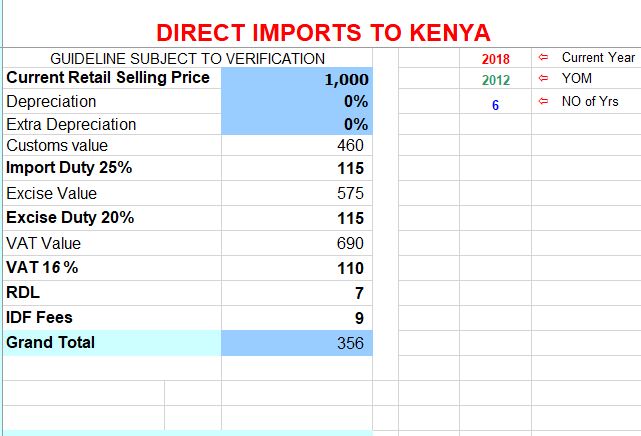
The Entire Calculation Flow
CRSP
↓
Depreciation
↓
Customs Value
↓
Import Duty
↓
Excise Duty
↓
VAT
↓
IDF
↓
RDL
↓
Total Taxes
↓
Estimated Landed Cost
How the CRSP Works in Practice
Suppose you're importing a Toyota Land Cruiser 250 VX. The CRSP schedule identifies the vehicle by matching details such as the model, engine size, and fuel type. After the appropriate CRSP value is retrieved, KRA applies the depreciation percentage according to the vehicle's age. The resulting customs value becomes the basis for calculating all applicable import taxes and levies.
This means that two vehicles with similar purchase prices but different specifications may attract different import taxes because their CRSP values differ.
Monolith Africa Turning Data Into Better Buying Decisions.
Why Accurate Vehicle Selection Matters
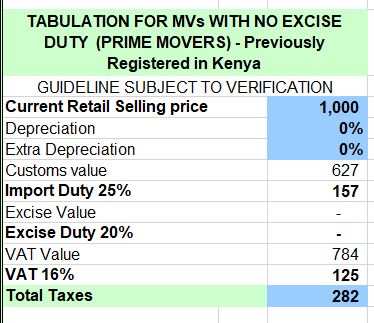
When using a vehicle import duty calculator, selecting the correct make, model, engine capacity, and fuel type is essential. Choosing the wrong vehicle variant may result in an inaccurate customs value and an incorrect estimate of the taxes payable.
For this reason, advanced import duty calculators—such as the one Monolith Africa is building—use the official CRSP database to automatically identify the correct vehicle before performing any calculations.
What Is a KRA Import Duty Calculator?
A KRA import duty calculator estimates the taxes and charges payable when importing a vehicle into Kenya. It combines the customs value with applicable taxes and government charges to produce an estimated landed cost.
A good calculator helps you answer questions like:
- How much import duty will I pay?
- How much VAT is charged?
- What is the estimated total landed cost?
- Is importing cheaper than buying locally?
Why Does KRA Use the CRSP?
Vehicle prices vary from one exporter, auction, or country to another. To create a fair and consistent tax system, KRA uses the CRSP as a standardized reference instead of relying only on the invoice price presented by the importer.
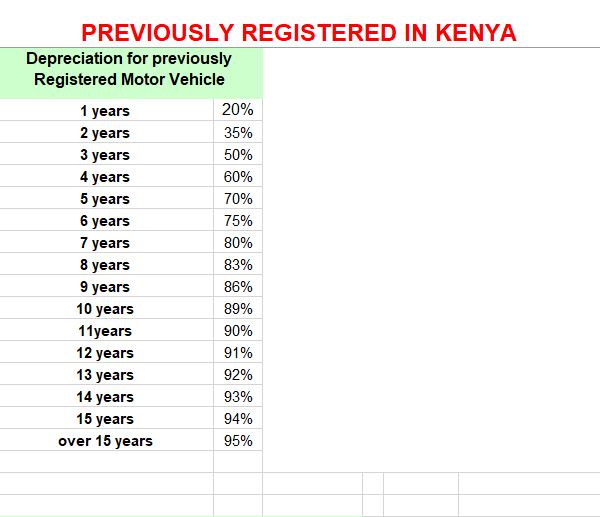
Once the correct vehicle is identified in the CRSP schedule, KRA applies the relevant depreciation based on the vehicle's age to determine the customs value. Import duty, excise duty, VAT, Import Declaration Fee (IDF), and Railway Development Levy (RDL) are then calculated from this value.
Information Needed
To generate an estimate, most calculators require:
- Vehicle make
- Model
- Year of manufacture
- Engine capacity
- Fuel type
- Transmission
- FOB price
- Shipping cost
- Insurance
More advanced calculators can also use the relevant CRSP value for the selected vehicle to improve the estimate.
Charges Included
The total landed cost can include:
- Customs value
- Import duty
- Excise duty
- VAT
- Import Declaration Fee (IDF)
- Railway Development Levy (RDL)
- Shipping
- Marine insurance
- Clearing and forwarding
- Registration costs
Knowing these costs upfront reduces the risk of unexpected expenses after the vehicle arrives in Kenya.
Why Importers Use a Duty Calculator
A calculator allows buyers to:
- Compare multiple vehicles before purchasing.
- Estimate monthly financing requirements.
- Decide whether importing or buying locally offers better value.
- Plan their budget before paying a deposit.
It also makes it easier to compare different model years and engine sizes, since taxes can vary depending on the vehicle.
Beyond the Duty Estimate
The duty calculation is only one part of importing a vehicle. Buyers should also consider:
- Exchange rate movements.
- Auction grades and vehicle condition.
- Shipping schedules.
- Insurance.
- Financing options.
- Local market prices for similar vehicles.
Looking at the entire supply chain leads to better purchasing decisions than focusing only on the advertised price.
How KRA Calculates Vehicle Import Duty in Kenya (Step-by-Step)
Many first-time importers think KRA simply taxes the price they paid in Japan. In reality, KRA follows a structured process that starts with the Current Retail Selling Price (CRSP) and then applies depreciation before calculating the different taxes.
Let's break it down.
Step 1: Determine the Current Retail Selling Price (CRSP)
Every vehicle in the KRA CRSP schedule has a Current Retail Selling Price (CRSP).
For example:
| Vehicle | CRSP |
| 2018 Lexus NX300 | KSh 7,156,212 |
| Toyota Prado TX | KSh .. |
| Mazda CX-5 | KSh .. |
This value represents KRA's reference retail price for that vehicle before depreciation.
Tip: Your actual purchase price in Japan does not automatically become the taxable value.
Step 2: Apply Depreciation
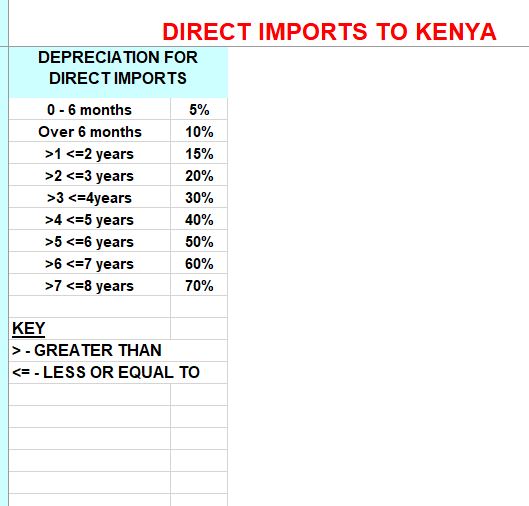
KRA then reduces the CRSP based on the vehicle's age.
Direct Imports
| Vehicle Age | Depreciation |
| 0–6 Months | 5% |
| Over 6 Months | 10% |
| 1–2 Years | 15% |
| 2–3 Years | 20% |
| 3–4 Years | 30% |
| 4–5 Years | 40% |
| 5–6 Years | 50% |
| 6–7 Years | 60% |
| 7–8 Years | 70% |
Example
Suppose your vehicle is 6 years old.
CRSP
KSh 7,000,000
Depreciation
Remaining Customs Value
Step 3: Calculate Customs Value
The Customs Value is the depreciated CRSP.
Formula:
Customs Value = CRSP × (100% − Depreciation)
CRSP
7,000,000
Depreciation
50%
Customs Value
3,500,000
Step 4: Calculate Import Duty
Import Duty is charged on the Customs Value.
Formula
Import Duty
=
Customs Value × Import Duty Rate
Example
Customs Value
3,500,000
Import Duty
875,000
Step 5: Calculate Excise Duty
Excise Duty is calculated after Import Duty has been added.
Formula
Excise Value
=
Customs Value + Import Duty
Then
Excise Duty
=
Excise Value × Excise Rate
Different vehicles may attract different excise rates depending on the applicable tax rules.
Step 6: Calculate VAT
VAT is calculated after Import Duty and Excise Duty.
Formula
VAT Value
=
Customs Value
+
Import Duty
+
Excise Duty
Then
VAT
=
VAT Value × 16%
Step 7: Add IDF and RDL
Finally, KRA adds:
- Import Declaration Fee (IDF)
- Railway Development Levy (RDL)
These are charged on the customs value according to the applicable rates.