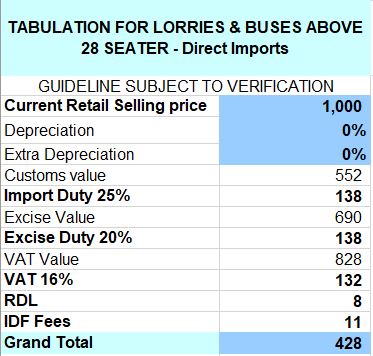
This table looks confusing at first, but it's actually just KRA adding taxes one after another. Imagine you're buying a pizza and every government office adds a small fee before you can take it home.
KRA Current Retail Selling Price Explained (3-Minute Read)
TLDR(Too Long Didnt Read)
Step 1: Current Retail Selling Price (CRSP)
CRSP = 1,000
Think of this as KRA saying:
"We believe this car is worth KSh 1,000."
It doesn't matter if you bought it cheaper. KRA starts from their value, called the Current Retail Selling Price (CRSP).
Step 2: Depreciation
Cars lose value as they get older.
Example:
- New car = KSh 4,000,000
- 8-year-old car = maybe KSh 2,200,000
That reduction is called depreciation.
Step 3: Customs Value
Now KRA doesn't charge tax on the full retail price.
They first remove local costs such as:
- Dealer profit
- VAT already included
- Local transport
- Other retail costs
CRSP = 1,000
Customs Value = 552
Retail Price
│
▼
Remove local Kenyan costs
│
▼
Customs Value
Step 4: Import Duty (25%)
Now KRA says:
"Because you imported this car, pay 25%."
So
552 ×25% equals 138
Import Duty = 138
Step 5: Excise Value
Here's where many people get confused.
KRA now says:
"Let's add the Import Duty back."
So
Customs Value
552
+
Import Duty
138
=
690
Excise Value = 690
Step 6: Excise Duty (20%)
Now another tax.
690
×20% =138
Excise Duty = 138
Step 7: VAT Value
Customs Value
552
+
Import Duty
138
+
Excise Duty
138
=
828
VAT Value = 828
Step 8: VAT (16%)
Now
828 ×16% =132
That's your VAT.
Step 9: Railway Development Levy (RDL)
Small government levy.
Usually
1.5%
Step 10: Import Declaration Fee (IDF)
Another government fee.
Usually
2%
of Customs Value.
Here
11
Step 11: Grand Total
Finally KRA adds only the taxes.
Import Duty
138
+
Excise
138
+
VAT
132
+
RDL
8
+
IDF
11
=
428
If you've ever imported a vehicle into Kenya or are planning to buy one from Japan, the term CRSP is one of the most important concepts you need to understand. Many first-time importers assume that taxes are calculated using the price they paid for the vehicle. Unfortunately, that's not how Kenya's tax system works.
Instead, the Kenya Revenue Authority (KRA) uses the Current Retail Selling Price (CRSP) to determine the customs value used when calculating import duty and other taxes. Understanding how CRSP works can help you budget accurately, avoid unexpected costs, and make better vehicle-buying decisions.
What Does CRSP Mean?
CRSP stands for Current Retail Selling Price. It is an official valuation list published by KRA that assigns a retail value to thousands of vehicle makes, models, engine capacities, fuel types, and trim levels.
Rather than relying solely on the invoice issued by the overseas seller, KRA refers to this standardized valuation when calculating taxes on imported vehicles. This creates a consistent approach for vehicles of the same specification entering Kenya.
For example, if two people import the same vehicle model with identical specifications, KRA generally uses the same CRSP value as the basis for tax calculations, regardless of differences in purchase price.
Why Doesn't KRA Use the Purchase Invoice?
One of the biggest misconceptions among vehicle importers is that paying less for a car automatically means paying less tax.
In practice, invoice prices can vary because of factors such as:
- Special discounts
- Auction purchases
- Accident or salvage vehicles
- Promotional offers
- Negotiated prices between buyers and sellers
Because invoice prices are not always consistent, KRA relies on the CRSP valuation system to create a standardized reference point when assessing imported vehicles.
How CRSP Affects Import Duty
The CRSP value forms the starting point for calculating the taxes payable when importing a vehicle into Kenya.
Typical charges include:
- Import Duty
- Excise Duty
- Value Added Tax (VAT)
- Import Declaration Fee (IDF)
- Railway Development Levy (RDL)
Since these taxes are linked to the vehicle's assessed value, understanding the correct CRSP helps you estimate your total landed cost before importing.
What Information Is Included in the CRSP List?
The KRA CRSP database contains detailed information for thousands of vehicles, including:
| Information | Example |
| Make | Toyota |
| Model | Harrier |
| Engine Capacity | 2000cc |
| Fuel Type | Hybrid |
| Body Type | SUV |
| Seating Capacity | 5 |
| Gross Vehicle Weight | 2,155 kg |
| CRSP Value | Used as the valuation reference |
Even small differences in specification—such as engine size, fuel type, or trim level—can result in a different CRSP value.
Why Engine Capacity and Fuel Type Matter
Two vehicles may look identical but attract different taxes because of their specifications.
For example:
- Toyota Harrier 2000cc Petrol
- Toyota Harrier 2500cc Hybrid
Although they share the same model name, they may have different CRSP values and therefore different tax calculations.
This is why a reliable import duty calculator asks for details such as make, model, engine capacity, and fuel type.
Can You Check the CRSP Before Importing?
Yes. Reviewing the CRSP for your preferred vehicle before making a purchase is one of the smartest things you can do.
Knowing the estimated CRSP allows you to:
- Budget for total import costs
- Compare different vehicle models
- Estimate taxes before paying a deposit
- Avoid unexpected charges after the vehicle arrives in Kenya
Using a CRSP-based calculator also lets you compare multiple vehicles before making a final decision.