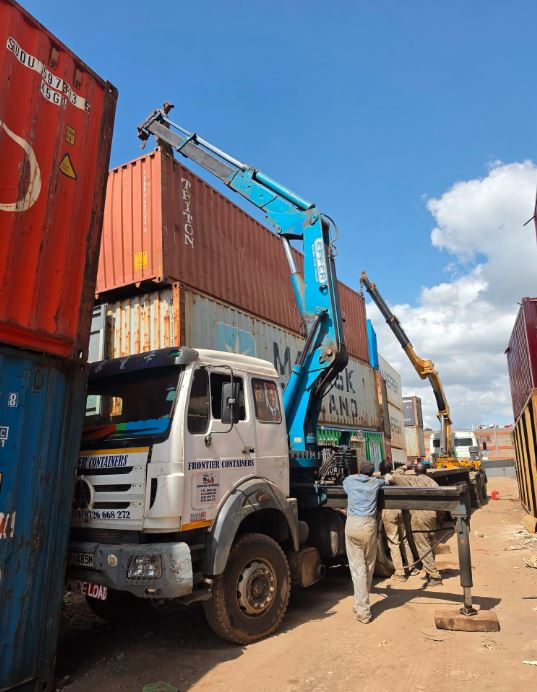
Never Pay Just Because You Were Sent a Pin Location
A location pin proves where something is. It doesn't prove who owns it. Similarly, photographs, videos, a container number, someone's WhatsApp profile picture or the fact that a salesperson knows exactly where the container is located should not individually be treated as proof of ownership. For a substantial purchase, the payment recipient should also make sense in relation to the verified seller.
If you're dealing with ABC Containers Ltd, for example, but suddenly you're instructed to send the money to an unrelated individual's account, stop and verify why.
Finding a cheap container for sale in Kenya can save you money, but an unusually attractive deal can also become an expensive mistake.Used 20ft and 40ft shipping containers are advertised through container yards, online marketplaces, social media, roadside signs and even telephone numbers placed on electricity poles. Some are genuine bargains. Others require considerably more verification.
The biggest mistake is assuming that because you can physically see a container, the person asking for payment necessarily owns it or has authority to sell it.
Cheap Container Prices in Kenya: What Are Buyers Seeing?
Online advertisements show just how wide the market can be.In the listings we reviewed, advertised prices included examples around KSh 150,000–160,000 for some 20ft containers, while some advertised 40ft units were around KSh 250,000–255,000.Condition, age, location, container type, delivery and modifications can change the final cost substantially.This is why buyers should be careful with statements such as:
“20ft container only KSh 100,000 — pay deposit now.”
The lower the price compared with comparable containers, the more important verification becomes.
The Roadside Container Trap
Here's something many first-time buyers may not consider.You may see a container sitting beside a road, yard, petrol station, construction site or business premises with a “FOR SALE” notice and telephone number.
That does not automatically prove that the advertiser owns the container.
A dishonest advertiser could potentially identify somebody else's container, advertise it without authorization and attempt to collect money from interested buyers.
Think about the psychology.
You call and ask:
“Can I see the container?”
They tell you where it is.
You arrive.
The container genuinely exists.
Your suspicion drops because you've physically seen what you're supposedly buying.
But the important question isn't:
“Does the container exist?”
It is:
“Does this person have the legal authority to sell this particular container?”
Those are completely different questions.
A Real Lesson: Even a 40ft Container Can Become a Scam Target
Container fraud isn't necessarily limited to tiny online deposits.People can lose substantial amounts while trying to purchase something as large and visible as a 40ft shipping container.That sounds surprising because buyers naturally think:
“How could somebody scam me over something this big?”
But the size of the asset doesn't prove ownership.The container can exist while the seller, payment instructions or claimed ownership are false.
SEEING THE CONTAINER IS NOT THE SAME AS VERIFYING THE SELLER.
Used Containers for Sale in Nairobi: Don't Let “Cheap” Make the Decision
Searches such as used containers for sale in Nairobi, second-hand containers for sale in Kenya and cheap containers for sale in Kenya show strong buying intent.But don't compare sellers using price alone.A KSh 150,000 container isn't necessarily a better deal than one costing KSh 220,000.The cheaper unit could have extensive corrosion, damaged flooring, leaking sections, difficult doors, expensive transportation requirements—or the advertisement itself may require verification.Compare the total landed cost and condition, not merely the headline price.
How to Check a Container Before Paying
Before transferring a deposit or full purchase price, slow the transaction down enough to verify what you're buying.
First, inspect the actual container, not just photographs sent through WhatsApp.
Record its identification markings/container number where applicable and inspect the doors, locking mechanisms, roof, floor, corner posts and walls.
Then verify who is selling it.
For a company, request an official quotation containing the business details and payment instructions. Where appropriate, independently verify the company and confirm that the person you're communicating with represents it.
What About Old Containers?
A cheap container isn't necessarily fraudulent simply because it is old.
You may encounter containers manufactured many years ago, including units dating to the 1990s.
Age affects what you should be willing to pay, but condition and intended use matter enormously.
An older container may still work for stationary storage or conversion if appropriately inspected. However, serious corrosion, structural deterioration, floor damage and previous modifications can turn a cheap purchase into an expensive repair project.
For freight use, additional safety and certification requirements can apply.
20ft vs 40ft: Which Cheap Container Is Better Value?
A 40ft container provides roughly twice the floor area of a 20ft container, so businesses requiring substantial storage may find the larger unit more economical per square metre. However, consider transportation. A cheap 40ft container sitting hundreds of kilometres from your site may stop being cheap once transportation, lifting and placement are added.
Always ask for: Container price + transport + offloading + modifications/repairs = actual acquisition cost.
Red Flags When Buying a Container
Be extra careful when several warning signs appear together: a price dramatically below comparable listings, pressure to pay immediately, refusal to provide an official quotation, payment to an unrelated person, inability to explain ownership, refusal to let you properly inspect the unit, changing payment details, or claims that documentation will only be provided after payment.
None of these automatically proves fraud by itself, but they are reasons to verify further before sending money.